
Why check the Scam Detector Score Before You Trust a Web Design or Digital Marketing Company
Most Colombo business owners pick an agency the wrong way.
They look at the paid awards. They count staff. They count client logos or they pick the cheapest quote that promises the fastest delivery.
None of that tells you if a digital marketing agency can grow your business. Worse, all of it is easy to fake.
Smart business owners now add one more step.
They paste the agency’s website into a free tool like Scam Detector and read the trust score. A high number feels safe. A low number feels like a warning.
This article shows you what that score really means, where it breaks in Sri Lanka, and the checks that actually protect you.
We will also do something most agencies avoid. We will run the same test on ourselves and show you the result.
What a Scam Detector score actually measures
Scam Detector gives any website a score from 1 to 100. It says the number comes from 53 factors. When you read the fine print, those factors are mostly technical signals about the website, not about the business behind it.
The tool checks things like,
- Domain age, or how long the website has existed
- Whether the site uses HTTPS, the padlock that means traffic is encrypted
- The SSL certificate, the file that powers that padlock
- Whether the domain sits on any spam or malware blacklist
- The site’s server location and IP address
- Whether the site has a privacy policy, terms of use, and contact details
- Reports of spam linked to the site
Read that list again.
Every item is about web hygiene. Is the site set up cleanly and safely.
Not one item asks the real question you care about.
Will this agency grow my traffic, or quietly damage it.
That gap is the whole problem.
Why the score breaks in Sri Lanka
We checked 8 digital marketing and web design agency websites on Scam Detector. The scores ran from 12 to 89 and all of them rank on the Top 10 SERPs on Google. They did not match real-world reputation at all.
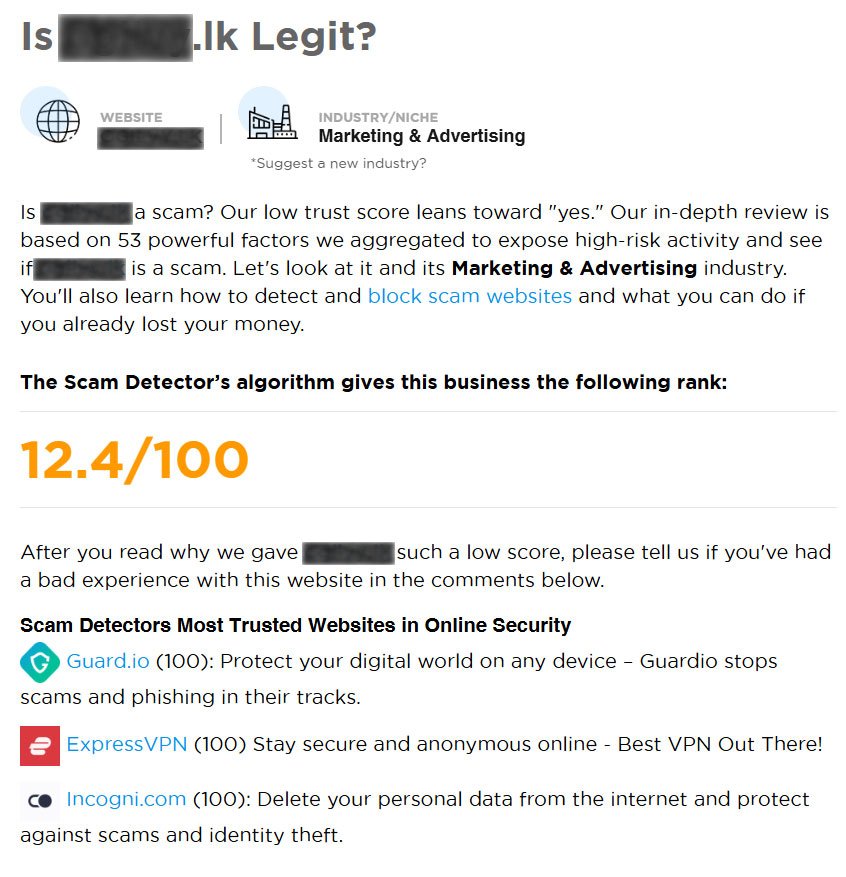
Here is the sharpest example. The Sri Lankan website of one of the most famous advertising companies in the world scored 12.4 out of 100. The tool frames a number that low as leaning toward scam.
Nobody believes that company is a scam. The low score was about web signals the tool could read, not the quality of the work.
Two reasons explain most of the strange results.
First, the .lk registry. Global tools read ownership data from public WHOIS records. WHOIS is the public directory that lists who registered a domain. The .lk registry does not expose that data to the world the way .com does. So a global scanner often cannot read a legitimate local agency’s details, then marks it down for missing information.
Second, the signals can be gamed in both directions. A weak web design agency can buy an old domain to inherit instant age and authority. They can buy bulk backlinks. A scanner sees these signals and reads them as strength. The score goes up while the skill stays low.
The reverse also happens. A digital marketing agency can be attacked. A rival can fire thousands of spam links at your domain to try to get you penalized by Google. This is called Negative SEO. The victim’s score and rankings can drop for months through no fault of their own. More on that below.
One more trick is worth naming. In low competition local searches, some agencies register an exact-match domain, a phrase like web design company in sri lanka, and stuff it with links. It can still rank, even though Google released an update in 2012 built to reduce exactly this.
The tactic is fragile, but in thin niches it survives long enough to win contracts.
The score is not the independent verdict it looks like
Two facts most owners miss.
The score can be negotiated. Scam Detector invites website owners to email business documents and dispute their score. In their own words, the more proof you send, the higher your score goes. So part of the number reflects who bothered to contact them, not pure analysis.
The most trusted boxes are ads. The security products listed beside the score are paid affiliate links. They are not a ranking of merit. Do not read that sidebar as an endorsement.
How to read the score the right way
Use it as a first check, never the final word.
- A high score, roughly 80 to 100, means the website has basic hygiene and no active spam or malware flags. It does not mean the web design company in Sri Lanka is good. Start your real checks now.
- A low score, under 50, is a prompt to look closer, not a verdict. Check if the site uses a .lk domain. Check if the company is new. Check for credible Google Reviews. Then judge.
The score tells you the website is technically clean. It cannot tell you the people behind it will protect your brand. A higher score often gives you an indication that they have got the basics right.
The checks that actually protect you
This is the part that matters. Five steps. Each one is hard to fake.
Demand read-only analytics access. Ask to see one past client’s results inside Google Analytics, not a screenshot. Screenshots are edited in minutes. Raw access is not. If they refuse, walk away.
Confirm you own everything from day one. Put it in writing that you own the domain, the hosting account, and the analytics property. Some web design agencies hold these to trap you into renewing contracts. Your assets should never sit in their name.
Check the backlink history, and read it correctly. Run their domain through a backlink tool. Spammy or foreign-language links can mean two opposite things. The agency bought them, which is bad. Or the agency was attacked, which makes them a victim. Ask them directly. A real operator can show you the disavow file, the list they sent Google to reject bad links, and explain the recovery.
Test skill over price. A very cheap quote usually means automated spam work. Ask how they build authority. If the answer is guaranteed link quantities or private networks, that is a long-term risk to your brand.
Ignore the vanity signals. Office size, staff count, client logos, and paid awards are marketing, not proof. Results and transparency are proof. Read their Case Studies.
We ran the test on HypeX Digital
To be fair, we should face our own checklist. Right???
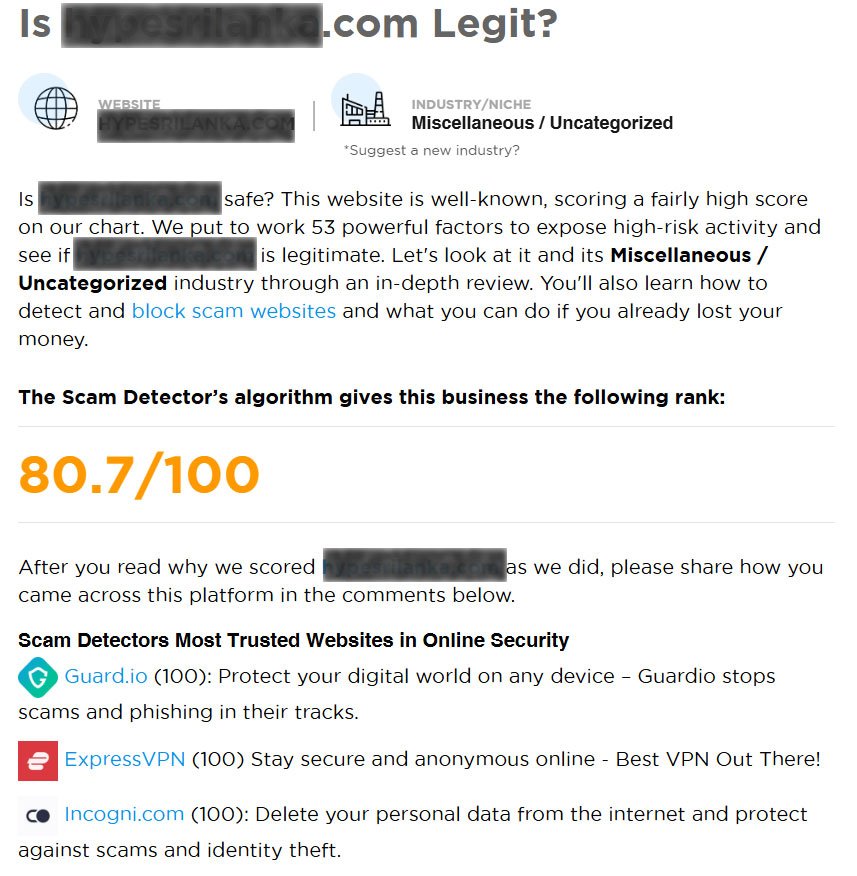
HypeX Digital scored 80.7 on Scam Detector, tagged “Fair. Valid. Known,” with no blacklist flags. www.hypesrilanka.com is clean. But we will be honest about what that number is worth. While scoring us, the tool noted it could not even read the website content, most likely because of Cloudflare security setup. It still gave a fair score from domain and security signals alone. That proves our point. The number reflects hygiene, not the work.
www.hypesrilanka.com domain was hit with a spam-link attack. Recovery took close to a year, and the climb back was slow. If you ran a backlink check on it during that time, you would have seen over 700 toxic links and could have wrongly assumed these were bought links. It wasn’t. All those links were targeting one article about Puma.
That is exactly why step three above matters. Ask before you judge.
Run your checklist on your current agency too. We believe that they would rather earn your trust through access and proof than through a logo wall.
The bottom line
An automated tool can tell you if a website is technically clean.
It cannot obviously tell you if the digital marketing company behind it will grow your business or quietly harm it.
Use Scam Detector as your first five-second check. Then do the real work.
Demand access. Confirm ownership. Read the link history with care. Reward skill, not price.
Truth takes a little effort. It is far cheaper than hiring the wrong partner.
Frequently asked questions
Is a low Scam Detector score proof that an agency is a scam?
No. A low score often reflects technical signals the tool cannot read, such as a .lk domain with hidden registry data, a new domain, or a site hit by a spam-link attack. Treat a low score as a reason to look closer, not as a verdict.
Why do many Sri Lankan .lk agency websites get low trust scores?
Global scanners read ownership data from public WHOIS records. The .lk registry does not share that data worldwide the way .com does. The tool then marks the site down for missing information, even when the agency is legitimate.
Can a business change its Scam Detector score?
Yes. Scam Detector lets website owners dispute their score by emailing business documents. They state that more proof leads to a higher score. So the number is partly based on who contacts them, which is why it is not a fully independent measure.
What is the best way to check if a Sri Lankan web or SEO agency is legitimate?
Ask for read-only Google Analytics access to past work, confirm in writing that you own your domain, hosting, and analytics, review their backlink history and ask whether any spam links came from a purchase or an attack, and test their skill instead of choosing the cheapest quote.